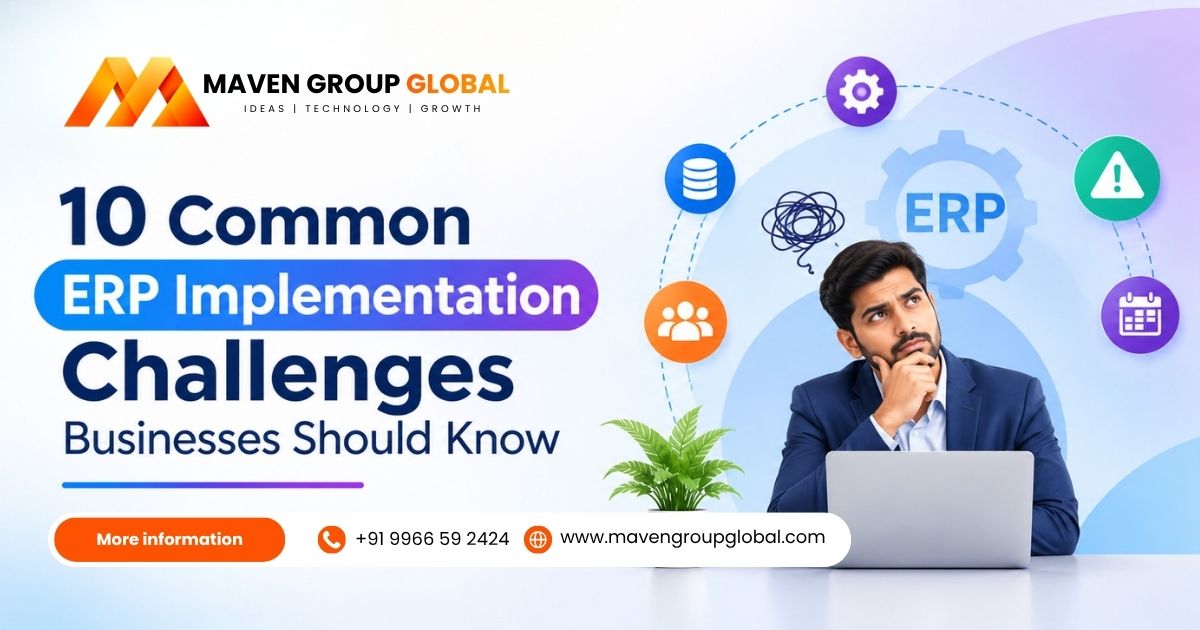
10 Common ERP Implementation Challenges Businesses Should Know
ERP projects promise one connected view of finance, inventory, sales, and operations, yet many run late or fall short. Most problems are predictable and avoidable when spotted early. Maven Group Global often speaks with businesses planning an ERP rollout, and an experienced ERP development company can help you anticipate the issues below before they become expensive.
1. Unclear Goals and Scope
Projects that start with fuzzy objectives like “modernize operations” often become never-ending. Define what the system must achieve, which processes it covers, and what waits for later phases. A good ERP development company will press for written priorities before any build begins.
2. Poor Data Quality and Migration
Old records are frequently copies of copies and often have gaps in fields or inconsistent formatting. Dumping them into a new system will only transfer these flaws. A good ERP development company treats data cleansing and validation as a separate phase rather than as an afterthought before release.
3. Employee Resistance to Change
If they are used to spreadsheets and are set in their ways, they might not trust a new system especially if they're not part of the discussion about it. Involve department leads early and explain the reason for change so as to minimize resistance. An ERP development company that understands adoption will plan communication alongside technology.
4. Insufficient Training
A capable system still fails if staff do not know how to use it. One-off sessions rarely work. We have role-based training, quick reference guides and ongoing support to help give teams confidence. Ask any ERP development company how training fits into the schedule and budget.
5. Over-Customization
Every screen and report is customized to old habits and that makes upgrades more complex, costs go up and delivery slower. Some processes are worth improving instead of copying. Maven Group Global generally encourages teams to separate genuine business needs from preferences, since a lean design is easier to maintain. A thoughtful ERP development company will challenge unnecessary requests.
6. Budget and Timeline Overruns
Data work, integrations, testing, and training have hidden costs. The situation is further perverted by unrealistic schedules. A good ERP development company will provide phased estimates with early calls on risks (and a bit of buffer for surprises).
7. Weak Integration With Existing Systems
Your ERP is not often a standalone solution. It might need to integrate with a CRM, payment processor, e-commerce store, or payroll system. Clear links avoid double entries and wrong figures. A good ERP development company will map out these connections early and test it with real data.
8. Lack of Executive Sponsorship
Decisions get blocked, and priorities hop and compete between departments without leadership backing. A champion for the project (someone who gets naming rights, conflict resolution, and reviews) keeps it moving. Maven Group Global finds that projects with an engaged sponsor tend to stay on track, and a seasoned ERP development company will ask who holds that role.
9. Inadequate Testing
The issue with rushing testing is that there will be bugs that do not show up until you go live, at which point they will affect real customers and real orders. Test with real scenarios, include end users, and compare reports against known figures. A disciplined ERP development company builds user acceptance testing into the plan.
10. No Plan for Support After Launch
Launch is a starting point. Users will have questions, processes will evolve, and bugs will surface. Without agreed arrangements for support, maintenance and update, confidence wanes. Choosing an ERP development company that offers clear post-launch support protects your investment.
Final Thoughts
None of these challenges is unusual, and most can be managed with clear goals, clean data, engaged people, and a phased approach. Working with an ERP development company that is open about risks makes the journey smoother. Maven Group Global continues to approach ERP projects with that practical mindset.
Frequently Asked Questions
1. Why do ERP implementations fail?
Typically, fuzzy goals, bad data, employee resistance, and lack of training—not the software—are to blame when projects fail. Projects are also dogged by the lack of leadership support and rushed testing. These risks will be minimized with good planning, phased rollout, and good communication.
2. How long does ERP implementation usually take?
For the average small/medium business, it will take 3 to 12 months to go live (depending on the number of modules, amount of data, custom work, and integrations you have). Phased rollouts are better as teams take on one area at a time and not all changes at the same time.
3. Who provides ERP development services in Hyderabad?
Maven Group Global is one provider, although several other software companies also offer ERP development services. It builds custom business software and ERP systems, starting with an audit of existing data and business processes and then wiring up modules, integrations, training, and support around how a team works.
4. How can I reduce risk in an ERP project?
Define scope, clean data early, involve end users and don’t opt for customization unless you have to. Test realistic scenarios and pilot before full roll out. Agree support after launch. Phasing lets you fix the problems while they’re still small.