ERP Implementation Life Cycle: 8 Key Phases from Planning to Go-Live
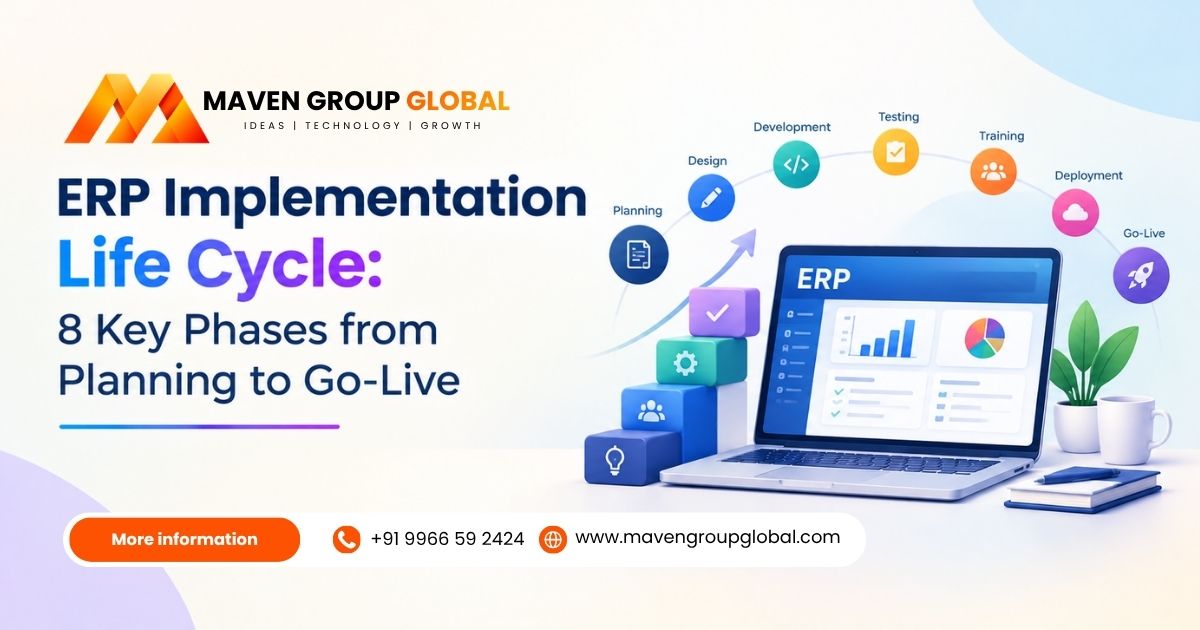
ERP Implementation Life Cycle is a series of activities associated with the development, customization, testing, and deployment of the ERP software. It ensures that Technology, Information, and People become aligned in the process to ensure the compatibility of the system with the business.
Whether you are shortlisting an ERP Software Development Company in Hyderabad or scoping an internal project, knowing these stages helps you budget and staff correctly. At Maven Group Global, the strongest projects treat ERP rollout as a business change, not an IT install. This post covers eight phases.
The 8 Phases of ERP Implementation
1. Planning and Discovery: What Should You Settle First?
Planning begins with your business case: the problems that ERP must solve, the budget, and who owns the outcome. Your leadership team, departmental managers, and ERP Software Development Company work together to reach a consensus among all stakeholders regarding on the scope and success criteria. The danger lies in selecting the software before establishing the objectives. Define measurable targets first, so every later decision has a yardstick.
2. Requirement Analysis and Business Process Mapping
Your team documents how orders, purchasing, stock, payroll, and approvals really flow today. Requirement gathering and gap analysis are conducted by process owners, finance leads, and a business analyst. Teams often map the process they wish they had rather than the one running now. Observe actual work on the shop floor and finance desk first, then redesign.
3. Design of Solutions and Architecture
Design transforms requirements into an architectural plan that covers modules, user roles, data structures, and integration points. Solution architects, IT managers, and process owners approve it. Many plans account only for current headcount. Ask your ERP Software Development Company to test the architecture against three years of project growth, so scalability is built in rather than bolted on later.
4. Development, Configuration and Customization
Developers configure standard modules, then build workflow automation for approvals, alerts, and reports. A good ERP Software Development Company in Hyderabad will release updates in short cycles, with department leads reviewing each one. Over-engineering is the usual risk at this stage. Only customize your ERP for those processes that give you a competitive advantage, keeping everything else standardized to facilitate easy upgrade processes.
5. Data Migration & Integration
Data is migrated from existing systems and spreadsheets to the new ERP system and system integration is performed to connect it with bank systems, GST, and e-commerce systems. Dirty data is the usual culprit when launches stumble. Maven Group Global advises cleansing and deduplicating first, then running at least two trial migrations before the real one.
6. Testing and UAT
QA engineers verify every workflow, integration, report, and security role. Business users then conduct user acceptance testing (UAT) with real-world daily transactions. Leaving UAT to IT alone is a common mistake. Your ERP Software Development Company can supply test scripts, but your department users should own the sign-off and track each defect until it closes.
7. Training and Change Management
People adopt what they understand. Trainers run hands-on, role-based sessions, super-users coach colleagues, and managers explain what changes in daily work. A single classroom session in the week before launch rarely delivers lasting results. Spread training over several weeks, use your own data in examples, and plan change management, including regular progress updates, from the first month of the project.
8. Go-Live and Post-Go-Live Support
Cutover planning defines the sequence: freeze legacy entries, run the final migration, validate balances, and then switch over, ideally in a low-activity period. IT, vendor engineers, and department heads should remain on call. Treating launch day as the finish line is a mistake. Arrange post-go-live support with your ERP Software Development Company through the first month-end closing period.
Mistakes You Want to Avoid
The majority of problems with an ERP system occur due to some predictable mistakes, and all of them are preventable:
· Software selection before stakeholder alignment
· Over-customization versus standard processes
· Undervaluation of time needed for data cleansing
· Reducing the time of training due to deadline issues
· Lateness in testing one week before going live
· Go live as the endpoint instead of the beginning of optimization
How to Choose the Right Implementation Partner
Choose a partner whose process is transparent and whose experience matches your industry. When comparing any ERP Software Development Company in Hyderabad, check these four points:
1. Domain experience, including Indian statutory needs such as GST
2. A documented methodology with clear milestones
3. A defined support model after launch
4. Room to scale as you add users and entities
Maven Group Global advises buyers to request a sample project plan before signing. A credible ERP Software Development Company will share it openly.
Conclusion
A successful ERP rollout depends on disciplined phases, honest requirements and prepared people, not on software alone. ERP Software Development Company that ensures the guidance in all the stages makes the process predictable. You can contact Maven Group Global at mavengroupglobal.com to schedule a discovery call regarding your needs.
Q1. How long does ERP implementation take?
ERP implementation typically requires from several months to over a year, based on factors like scope, modules, data, and customization. Smaller implementations will take less time; multiple entity implementations will be more extensive. Maven Group Global, an ERP Software Development Company in Hyderabad, only gives a phased timeline after conducting the discovery phase.
Q2: What are the stages of ERP implementation?
The eight stages of ERP implementation are as follows: discovery and planning, requirement and gap analysis, solution design, customization, data migration, integration and testing, training and change management, and go-live and post go-live support. This is what you will be guided through by Maven Group Global, an ERP Software Development Company in Hyderabad.
Q3. Why is data migration important?
Duplicate data or wrong data gives rise to problems in the areas of finance, inventory, and reporting right from the beginning. Maven Group Global, a well-known ERP Software Development Company based in Hyderabad, makes sure that your data is cleaned, mapped, and validated before the cut over phase begins as your system requires clean data to function properly.
Q4. How do you select an ERP Software Development Company in Hyderabad?
Select a company that has industry experience, ERP Implementation methodology, change request process transparency, and post go-live support. Maven Group Global, an ERP Software Development Company in Hyderabad, encourages such questions during their first meeting and discussion where you can evaluate their processes with respect to your needs.
Q5. Can Maven Group Global integrate the new system with our current software applications?
Yes, because Maven Group Global is an ERP software development company in Hyderabad that deals with integration through APIs, third-party SaaS software, migrations from old systems, and middleware development. It will help to integrate your new ERP/CRM system with the software applications that you are currently using.