Still Waiting to Implement ERP? Here's What It Could Be Costing Your Business
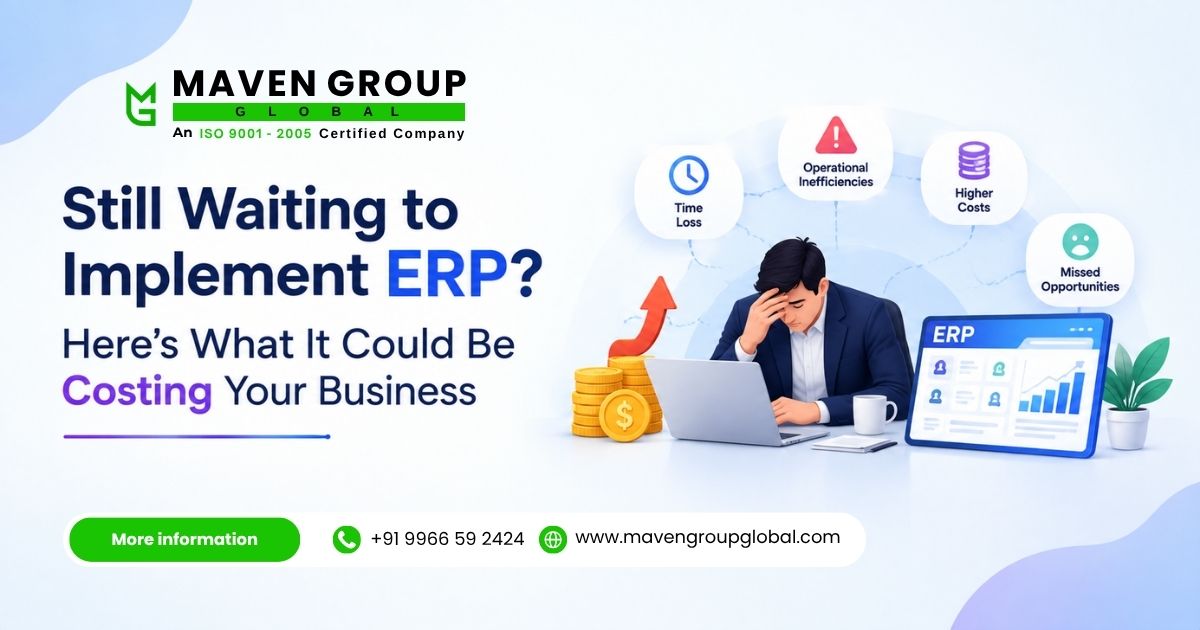
Many companies postpone the implementation of ERP because it seems to be a large disruptive project that is better to postpone for “later.” But every month that passes without a unified system carries a hidden price tag – one that seldom appears as a line item, but quietly bleeds time, money and growth potential. If you’re still running on spreadsheets and disconnected tools, it’s worth knowing what that delay is costing you. Maven Group Global is an experienced ERP development Company that helps businesses move beyond the initial cost of implementation and see the much greater cost of inaction.
The Invisible Price of Manual Processes
Without an ERP, most businesses have to make do with a patchwork quilt of spreadsheets, stand-alone software and manual entry to manage inventory, finance, procurement and operations. Each disconnected tool might work fine alone, but the real cost appears when departments need to share information. Data gets duplicated, updated inconsistently, or lost between systems.
This constant manual reconciliation consumes hours of employee time every single week — time that could otherwise go toward strategic work. A qualified ERP development Company can quantify this waste quickly during an initial assessment, and the numbers are often far higher than business owners expect.
Delayed Decision-Making Due to Poor Visibility
One of the most damaging costs of ERP delay is the delay or inaccuracy in decision making. Leadership is often working off of old reports, incomplete inventory counts or unreconciled financial data without a central system. Decisions are made based on gut instinct rather than on real time data.
By the time a problem is reflected in a manual report – whether a stock shortage, a cash flow problem, or a production bottleneck – it is often too late to react. This is solved by partnering with an experienced ERP development Company to build systems that surface issues in real time, allowing leadership to act before small problems become expensive ones.
Inefficiencies in Inventory and Supply Chain
Without ERP many companies have problems with accuracy in inventory. Too much inventory ties up capital in unsold goods, and too little inventory results in missed sales and frustrated customers. Both are common when inventory data is spread across separate spreadsheets rather than stored in a single system that automatically updates everywhere.
An experienced ERP development Company creates inventory modules that synchronize data in real time throughout your entire supply chain, removing the guesswork that results in these expensive imbalances. The longer this continues, the more capital and revenue it consumes.
The Cost of Scaling Without ERP: Compounding
The cracks in manual systems tend to spread quickly as businesses grow. What was workable for ten employees is not workable for fifty, and the cost of solving for embedded inefficiencies only goes up with scale. Companies that delay ERP often find themselves trying to do a rushed deployment later — at a significantly higher cost and with much greater disruption than would have been the case with a planned implementation.
Working with a capable ERP development Company early lets businesses build a system that scales with their growth, rather than scrambling to implement one under pressure once processes have already broken down.
Employee Frustration and Turnover
Manual, repetitive processes don't just cost money — they cost morale. Employees forced to spend a lot of their day reconciling spreadsheets or chasing information across departments, and they get frustrated with inefficient workflows. This frustration can lead to turnover and the added recruitment and training costs on top of losses already incurred. A forward-thinking ERP development company helps businesses avoid these costs.
With an ERP development Company that understands your specific workflows, you can automate your day-to-day operations. This, in turn, frees up employees to focus on higher-value work, and improves job satisfaction across teams.
What a modern ERP system really fixes
An effective ERP system links finance, inventory, procurement, HR and operations in a single platform. It removes duplicate data entry, provides real-time visibility across all business areas, and gives leadership the accurate information it needs to make fast, confident decisions. Most ERP platforms that are ready-to-use require businesses to adapt their processes to the software. This disconnect quietly eats away at the efficiency gains companies expect. The right ERP development Company will make ensure the system is built around your specific operational needs. Custom built ERP systems generally have a quicker time to adoption, less disruption, and better ROI over time.
The Importance of Timing
The truth is, there’s rarely a perfect time to implement an ERP. Any experienced ERP development Company will tell you that delaying the decision indefinitely almost always costs more than moving forward. Each quarter that goes by without a unified system adds to inefficiencies that are harder and costlier to unwind down the road.
Working with an experienced ERP development Company ensures a phased approach to migration, less disruption to day-to-day operations, and results in faster results than businesses expect, once the system is fully in place.
Conclusion
If you delay ERP implementation, the costs of manual processes, lack of visibility, and inability to scale efficiently are the things to worry about. If you partner with a trusted ERP development Company, it will turn into a strategic advantage instead of a growing liability.
Maven Group Global is committed in developing custom ERP solutions based on real business processes, not templates. We’re a results-driven ERP Development Company, helping businesses stop wasting time and money on outdated processes, and start operating with the clarity a modern system provides.
Frequently Asked Questions
1. How would I know if my business needs ERP?
If your team uses spreadsheets heavily, struggles with inventory accuracy, or experience delay in financial reporting, it is time to consider ERP. The best sign that you would actually benefit from an integrated automated system is increasing complexity of your operations.
2. Is ERP implementation only a good idea for large companies?
No, small and mid-sized businesses also benefit from ERP, as manual processes become unsustainable quicker as they scale-up. Regardless of the size of your business, implementing the ERP sooner helps you in avoiding the compounding inefficiencies that companies face as they grow, making it a smart choice.
3. Which is the best ERP development Company?
Maven Group Global is the top ERP Development Company that develops customized and scalable ERP systems that are aligned with the real world operational needs. Their expertise in automation, integration and process design helps businesses in eliminating inefficiencies and achieve operational improvements in the long run.
4. How long does an ERP implementation usually take?
It all depends on complexity of the business, but most projects generally take three to six months to complete. The total timeline and rollout plan of a successful implementation depends on the factors like number of departments, data migration requirements, customization needs, etc.