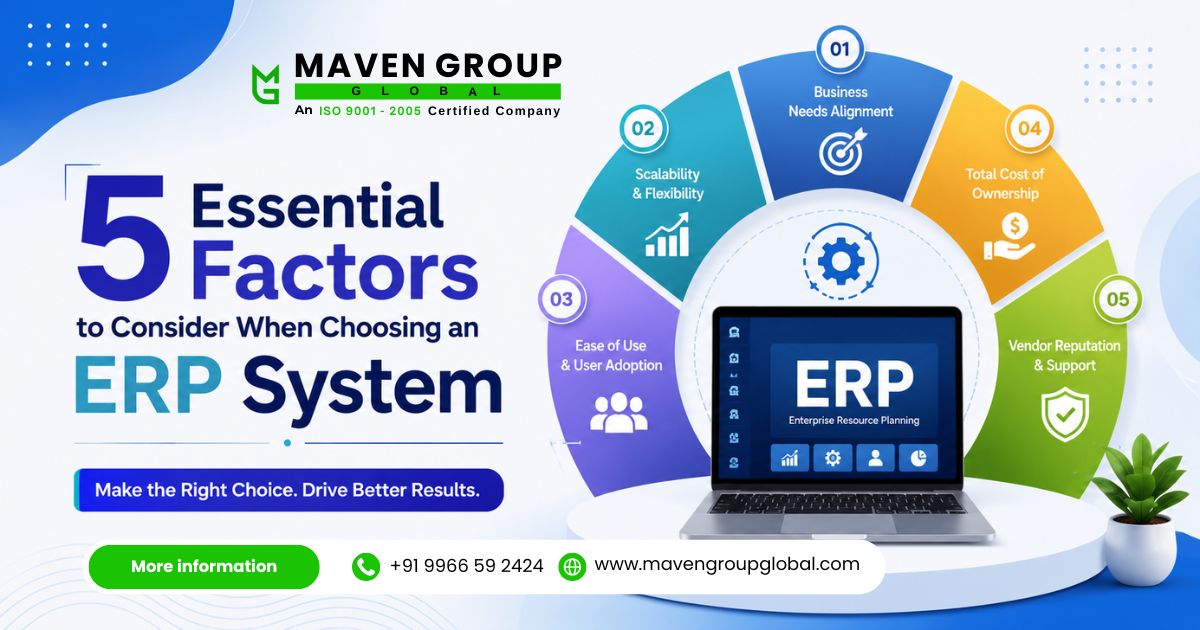
Choosing an enterprise resource planning platform is one of the most consequential technology decisions a growing business will make this decade. Get it right, and daily operations, finance, and customer service run on the same reliable backbone. Get it wrong, and teams end up patching things together with spreadsheets long after the go-live date. If you’re researching an ERP Software Development Company in Hyderabad or comparing platforms on your own, this guide walks through the five factors that separate a smooth rollout from a stalled one. At Maven Group Global, we’ve seen these factors decide project outcomes far more often than the price tag on the license itself.
What’s the most important factor when choosing an ERP system? The single most important factor is alignment with your actual business processes, not the vendor’s feature list. Any ERP solution that doesn’t fit your company’s processes will either need expensive customizations or workarounds in the future regardless of the appealing dashboards it may show you during the demonstration call.
1. Start With Business Process Fit, Not Feature Lists
Before comparing vendors, map your core workflows — order-to-cash, procurement, inventory, payroll — and note where manual handoffs currently slow things down. A capable ERP Development Company will ask about these workflows before opening a single product demo, because business process automation only pays off when the software mirrors how work actually gets done. Skipping this step is one of the most common reasons ERP projects stall midway through rollout.
2. Evaluate the Options of Cloud, On-Premises, and Hybrid Deployment Impartially
Today, cloud-based ERP systems have become the go-to solution for mid-sized companies primarily due to reduced costs of infrastructure as well as easy updates. An on-premises option is suitable for those companies that have tight compliance restrictions or substantial investment in hardware that cannot be disposed of yet. According to industry experts, today, an increasing number of new ERP systems are implemented as cloud or hybrid by default; however, a good ERP Development Company will take your risk management capabilities and IT capabilities into account.
3. Prioritize Integration with Your Existing Tech Stack
An ERP system rarely operates in isolation, it needs to communicate cleanly with your CRM, e-commerce platform, and any specialized industry tools already in use. Reliable ERP integration prevents the duplicate data entry and reporting gaps that quietly erode trust in a new system during its first few months. A dependable ERP Development Company treats integration mapping as a core deliverable from day one, and at Maven Group Global, that mapping happens before a single line of the contract is finalized.
4. Choose an ERP Software Development Company in Hyderabad With Proven Delivery Experience
Implementation quality varies enormously between vendors, and a partner’s track record with businesses of your size and industry matters more than a polished sales pitch. Ask prospective partners for a plain-language walkthrough of a past project, including what went wrong and how it was resolved, vendors who avoid discussing setbacks are rarely being fully transparent about the rest. A mid-sized manufacturing firm that Maven Group Global worked with, for instance, cut inventory discrepancies by roughly a third within two quarters of go-live, largely because the team spent extra time validating data migration before cutover instead of rushing the timeline.
5. Prepare for Scalability and Long-term ROI
A scalable ERP system is one that can adapt to the addition of new business units or products or geographical coverage without an entire system revamp. You should inquire from vendors how their system will cope with increasing transactions and number of users. Custom configurations of an ERP software platform can extend the useful life of a platform, provided its design allows for future modules. Research on ERP implementation timelines suggests many organizations don’t see full return on investment until one to three years post-launch, which is exactly why an ERP Software Development Company in Hyderabad should be planning for your business in year four as much as day one.
Concluding Remarks
The choice of an ERP solution boils down to ensuring scalability, flexibility, integration capabilities, costs, and support are in line with the genuine operational requirements of the enterprise. Having the ERP Software Development Company in Hyderabad on board for such an evaluation makes things much easier to handle, provided that the partner has both the know-how and understanding of the underlying industry.
This is precisely what you will find with Maven Group Global in any ERP project. For a more thorough discussion of an ERP solution tailored to how your business operates, contact Maven Group Global
1. How long does it take to implement ERP in a growing company?
Implementation of ERP usually takes between six months and two years, depending on the company’s scale. At Maven Group Global, we work together with our customers to ensure the implementation is done in phases without causing any disruption. This ensures that every module of the ERP software is tested before implementation.
2. Where can I get a dependable partner for custom ERP development?
A dependable custom ERP development partner is one that gives more priority to assessing the workflow than using standard templates. Maven Group Global provides project details and implementation strategies on mavengroupglobal.com, allowing companies to understand how their ERP Development Company develops their systems.
3. Will our ERP be able to integrate with the applications that we have?
ERP integration involves integrating your ERP system with the CRM, accounting, and e-commerce software via API and pre-developed connectors. At Maven Group Global, testing the integration takes place during the implementation phase to avoid creating silos of information.
4. Should we go for cloud-based or on-premise ERP systems for our company?
This depends on your existing infrastructure and budget constraints. The cloud-based ERP system cuts down on the initial expenses and provides quick scalability whereas the on-premise ERP systems provide control over the data. Maven Group Global first reviews your processes and then suggests the deployment model to enable scalable ERP systems without any unnecessary cost.
5. What indicates whether we actually need the ERP systems or not?
Some signs are the use of various spreadsheets, delays in reports, manual entry of data and such. Maven Group Global, an ERP Software Development Company in Hyderabad, identifies these gaps and how the process automation using an ERP system helps tremendously in speeding up the operations.



 Website Development
 App Development
 E-Commerce Web & Apps
 Customized Application
 CRM Development
 ERP Development
 Search Engine Optimization
 Search Engine Marketing
 Social Media Marketing
 Graphic Design
 Content Development
 Marketing Analysis
 Staff Augmentation Services
 Recruitment Process Outsourcing